Building a Meta Screen
I can’t say anything about the context of this work - who it was for, and what its intended use was. All I can say is you’ve definitely heard of the client (they are a globally known brand), and the problems we had to solve were super interesting!
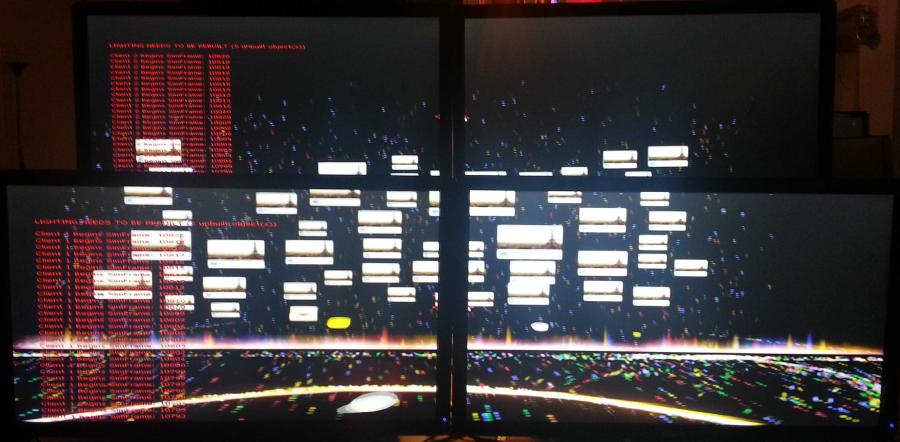
I was the lead engineer on the project. Our goal was essentially to use Unreal to drive a large multi monitor view of a single shared scene. Each monitor was to show only its part of the scene so as to create the effect of a single large monitor. For instance, you might create a large “meta” monitor out of nine actual monitors arranged in a 3x3 grid. The end effect is something you’ve likely seen before on wall-sized displays, scoreboards, and other things. The banner image at the very top of this post shows how our early stage prototype looked on a 2x2 setup. Skip to the bottom, if you want to see a short video of the demo in action.
The Plan
Our plan for doing this was to have each screen be attached to a running Unreal Instance, and have each such Instance running a game in perfect lock-step synchronization with each other. We also had to ensure the PRNG (pseudo random number generator) was well controlled and synchronized (so that, for example, any visual fx would be consistent across all Instances), and that every Instance used the correct view frustum matrix to show only its part of the scene.


I should note that there are very likely better solutions for the problem as written. However our client was telling us how they wanted it done, and I’m guessing they had their own reasons for this approach. They were very technical folks, accustomed to doing very technical things. We didn’t ask questions.
My Work
As the lead engineer, I had to:
- Change the Unreal camera frustum matrix so that it would only render to the areas of the screen I specified.
- Network all the scene components and keep every Unreal Instance in lock-step synchronization.
- Identify and fix (with another engineer) sources of PRNG sequence aliasing problems and sequence mismatches altogether.
Footage
I took the following video as part of an early milestone, to show that we had the tech foundation up and running.